
National Plant Collection® of Helianthus strumosus & tuberosus cvs.
Pages Home About Cultivation Contact My plants My Sources Desiderata Links
Jerusalem artichokes
plants that were for sale at The Friends of Treborth Botanic Garden plant sale in
April & May 2026
I have donated a number of Jerusalem artichoke potted and growing tubers to the plant sales at Treborth Botanic Garden this year. All were named cultivars so the label will tell you exactly what they are. Not all cultivars are available, there are a few of a selection I think will be of interest this year.
Helianthus tuberosus 'Bianca', or Helianthus tuberosus 'Boston Red', or Helianthus tuberosus 'Chinese' (not Chinese artichoke), or Helianthus tuberosus 'Dwarf', or Helianthus tuberosus 'Dwarf Sunray', or Helianthus tuberosus 'Fuseau', or Helianthus tuberosus 'Garnet', or Helianthus tuberosus 'Gerard', or Helianthus tuberosus 'Originals', or Helianthus tuberosus 'Papas Patio', or Helianthus tuberosus 'Red Fuseau', or Helianthus tuberosus 'Red Tupinambo', or Helianthus tuberosus 'Sakhalinski', or Helianthus tuberosus 'Stampede', or Helianthus tuberosus 'Sugarball', or Helianthus tuberosus 'Urodny', or Helianthus tuberosus 'White Fuseau', or Helianthus tuberosus 'Wilton Rose', or Helianthus strumosus 'Aurora Rubin', or Helianthus strumosus 'Blauange', or Helianthus strumosus 'Aurora Rubin', or Helianthus strumosus 'Herman', or Helianthus (tuberosus 'Dwarf Sunray × annuus 'Mongolian Giant') 'Bushy', or Helianthus (tuberosus 'Dwarf Sunray × annuus) 'Manifold', or Helianthus (tuberosus 'Dwarf Sunray × annuus 'Mongolian Giant) 'Tall'. Further information on the underlined cultivars (cultivated varieties) may be found elsewhere on this site by clicking on the name.
Although pictures online often show lovely yellow flowers remember that they are probably over head height, if they develop at all in our Gwynedd climate. Some cultivars are more likely to flower than others, which is probably late summer anyway. I have only had two plants flower each of the last two years, and these were different each time.
You may see above two cultivars of Helianthus strumosus. These are a different species but look very much like Jerusalem artichokes and produce tubers that look very similar, and are also eaten the same way. Both species came to Europe from what is now Canada and the USA in the 17th Century and both are now found growing wild in parts of Europe. So it is quite possible that there was some degree of cross breeding over the years although I have not read anything about this.
There are also three hybrid crosses of Helianthus tuberosus 'Dwarf Sunray' and Helianthus annuus / annuus 'Mongolian Giant'. These are part of work by Alison Tindale to try to achieve a tuber producing plant with dramatic flowers. The cross produces tubers just like Jerusalem artichokes, but the flowers have not changed that much.
Planting out: Beware when you plant out your purchase that the green shoots are NOT frost hardy. The tubers are hardy and so can be planted out in spring, even late winter, but that means you must keep an eye out for frost and cover the first growth with fleece or mulch. Also, slugs and snails are quite partial to the new growth. If they do attack the vigorous growing shoots will eventually win. Plant 15cm deep if you can see the tuber, if not make it 20cm.
In case you weren't aware Jerusalem artichokes are tall growing, usually 6 or 7 feet, although sometimes more, especially the cultivar 'Chinese'. In poor soil and or dry conditions this will be less. Earthing up the lower stem is said to help these tall plants in windier sites, but doesn't increase the crop, like potatoes. They will grow almost anywhere but for good crops need a moist soil and prefer a fertile soil. The tubers develop in late summer and autumn, so don't start to harvest until well into autumn and it's best for a bigger crop to wait until the stalks have gone brown. The tubers are fully hardy so can be left in the ground until needed, although some advice leaving the tubers for a couple of weeks to "ripen" after lifting. I don't know if that is necessary, but if you are new to the tubers only eat a TINY amount at first tasting and increase the amount VERY gradually. They contain a carbohydrate which is difficult to digest and will produce a lot of wind if your gut is not used to it. As time goes by some of this inulin turns to sugar which helps a little, but still slowly does it or you may be put off for life!
The plants are all grown in Fertile Fibre organic peat-free compost and are grown in re-used recyclable pots from Fron Goch Garden Centre Plant Pot Recycling Scheme.
The price of my donated plants is set by The Friends of Treborth Botanic Garden, and is used to further the work or the Botanic Garden and community activities organised by The Friends.
I started donating plants to the plant sale in 2024 and they sold well in 2025 as well, so it is my intention to continue to donate a small selection to all future April and May plant sales. This is the only place you can buy my plants as my Collection is not a commercial concern. I will however send tubers during the dormant season, at my convenience, for a donation to cover the cost to me to pack and post them to you. If you want a specific cultivar at either of the April or May Plant Sales, let me know as far ahead as possible and I will try to get something there for you. Email me if this is of interest.
Other pages on this site
Home About Cultivation Contact My plants My Sources Desiderata Links
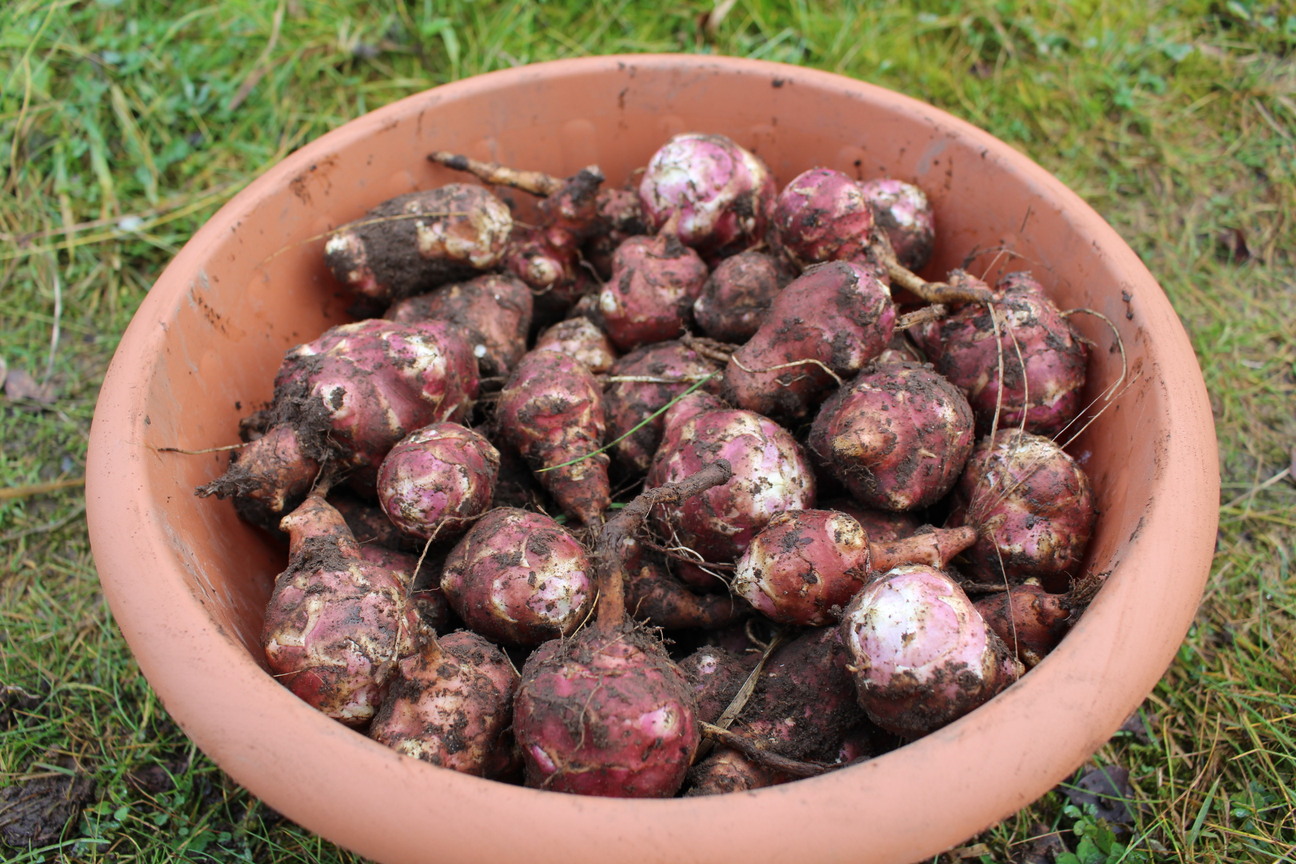
Jerusalem artichoke 'Red
Fuseau' tuber harvest
(Picture Copyright GardensForLife.ie)

Email; FTBGplantsale@artichokes.wales
This page last revised 23rd March 2026
Copyright © David
Barrett